Eleuthero Root
Taiga Root • Woody Shrub of Northern Forests, Traditionally Called an Adaptogen.
Explore the common forms, learn a little about the plant, and choose what suits your cupboard.
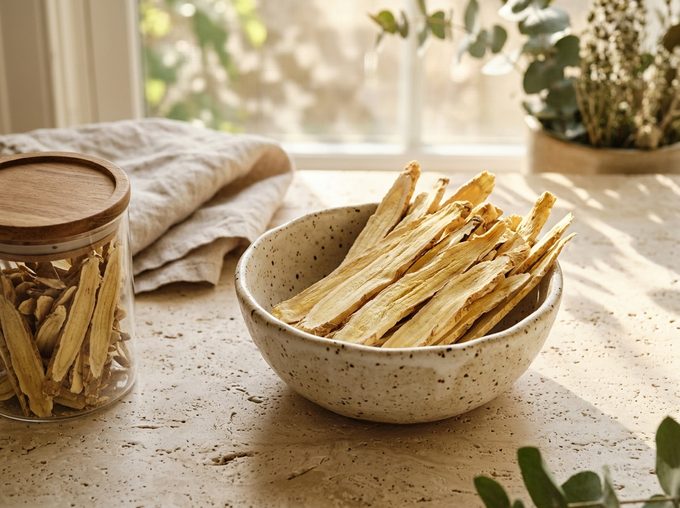
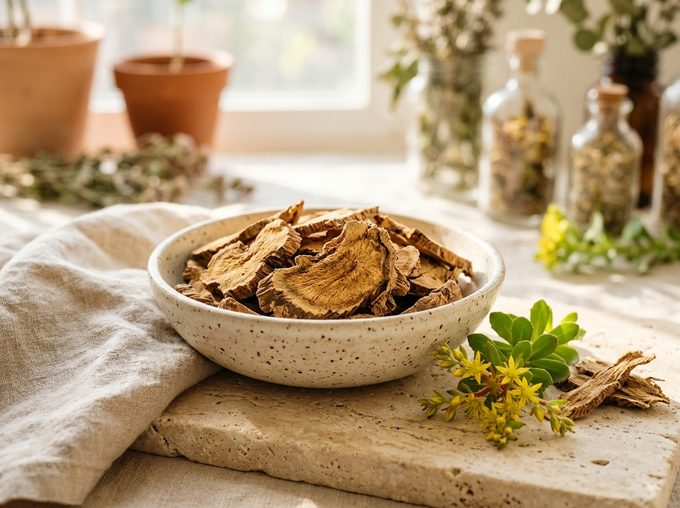
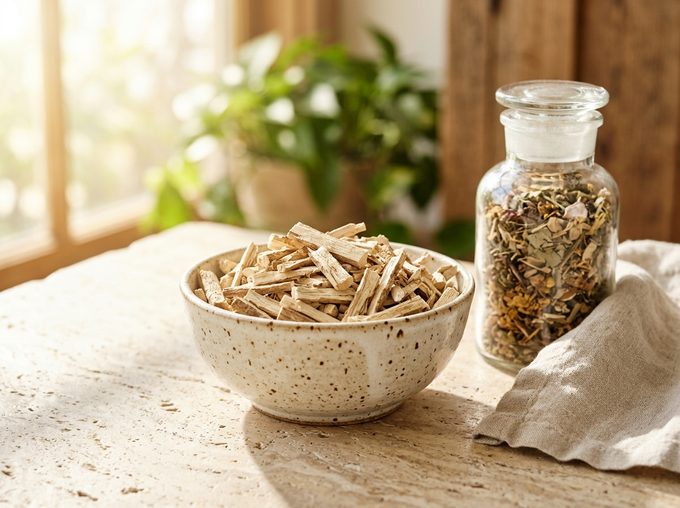
Dried eleuthero root pieces for simmering, decoctions, and jars.
A little about eleuthero root.
The plant
Woody, sweet-earthy, and mildly bitter-acrid with a clean forest-bark finish. Native to Northeastern Asia & Siberian Taiga (Araliaceae).
The forms
Most often prepared as a simmered root decoction using 3 g to 4 g (about 1 tbsp cut woody root chips) at 205°F–212°F low simmer (Simmer covered 20–25 min in 12 oz water).
Before you choose
Check the label for the Latin name (Eleutherococcus senticosus), and choose the form that suits your cupboard.
Traditional uses & research +
Botanical taxonomy: Eleutherococcus senticosus (Araliaceae) · Tradition: Adaptogens & Vitality · Key constituents: Eleutherosides (B & E), Polysaccharides, Phenolic compounds.
Curated collections: Adaptogenic Roots, Berries & Fungi · Seasonal almanac: November Almanac (Deep Autumn Adaptogens & Woodland Fungi).
Traditional background: Historically known as Siberian Ginseng (though botanically distinct from Panax species), Eleuthero was the original plant studied in the 1950s when researchers coined the term 'adaptogen'.
Everyday & kitchen uses: Simmered alongside astragalus, reishi, cinnamon, and ginger into deep winter root broths and morning decoctions.
Standard preparation methods (compare all 50 steeping temperatures):
- Simmered Root Decoction (3 g to 4 g (about 1 tbsp cut woody root chips) at 205°F–212°F low simmer): Simmer covered 20–25 min in 12 oz water
- Roasted Root Chai Base (1 tbsp eleuthero + 1 tbsp dandelion root + 1 cinnamon quill at Low stovetop simmer): Simmer 20 min; strain and add steamed oat milk
- Dual-Batch Root Re-Steep (Used root chips from first pot at 212°F simmer): Woody eleuthero chips yield a strong second 20-min decoction
Cautions & interactions +
General information, not medical advice. Check with a doctor or pharmacist before using this herb if you are pregnant, breastfeeding, giving it to a child, taking medication or managing a health condition.
Who should use caution: Safety in pregnancy and breastfeeding has not been established, and use is not recommended. It is also not recommended under age 12, and the EU monograph says not to take it for more than 2 months. Insomnia, irritability, fast heartbeat and headache may occur. It may raise blood pressure, increase bleeding and raise blood sugar, though sources differ. Possible interactions include digoxin and drugs handled by CYP3A4, such as cyclosporine, and one case of liver injury involved atorvastatin. A product labeled Siberian ginseng has been found to contain silk vine (Periploca sepium) instead.
Species & lookalike verification: Eleuthero (Eleutherococcus senticosus, formerly Acanthopanax senticosus) was historically marketed as 'Siberian Ginseng.' In 2002, the U.S. Congress passed legislation requiring it to be labeled 'Eleuthero' because only species in the genus Panax (American Ginseng Panax quinquefolius and Asian Ginseng Panax ginseng) may legally be called 'Ginseng.' While both belong to the Araliaceae family, Eleuthero contains eleutherosides (B and E) rather than Panax ginsenosides. Never confuse with Periploca sepium ('Chinese Silk Vine'), a reported adulterant in a product labeled Siberian ginseng.
Cupboard storage (amber glass guide): Store dried woody root chips in sealed glass jars; virtually indefinite shelf stability when kept dry.
Sources & further reading +
Why was the name changed from 'Siberian Ginseng' to 'Eleuthero'?
In 2002, U.S. federal labeling laws restricted the word 'ginseng' strictly to plants in the genus Panax. Although Eleuthero belongs to the same botanical family (Araliaceae) and was the very plant Soviet scientist Dr. Israel Brekhman studied when defining the concept of an 'adaptogen' in the 1950s, its active compounds are eleutherosides rather than ginsenosides.
How is Eleuthero different from Asian Red Ginseng in how it feels?
In traditional terms, Red Panax ginseng is described as strongly warming and stimulating, which can sometimes cause jitteriness or overheating in sensitive people. Eleuthero is energetically neutral-to-mildly-warming in those same terms. It has been promoted for endurance, but good human evidence for that use is lacking, and insomnia and irritability can occur.
Can you simmer the same batch of Eleuthero root chips twice?
Yes! Because Eleuthero consists of dense, woody root fibers, herbalists find the first 20-minute simmer does not exhaust the chips. Refrigerate the strained chips and simmer them a second time within 24 hours.
How do you make Eleuthero decoction taste richer?
Simmer Eleuthero root chips alongside Astragalus slices, fresh ginger, a few Schisandra berries, or Ceylon cinnamon.
Companion Moss & Thyme guides & tools:
- Herbarium Journal: Covered Infusions vs. Simmered Decoctions →
- Equipment Guide: Best Mortars, Pestles & Apothecary Grinders →
- Interactive Calculator: Infusion vs. Decoction & Safety Checker →
Botanical references:
- Royal Botanic Gardens, Kew — Plants of the World Online: Eleutherococcus senticosus Taxonomic Record ↗
- PubChem / NIH National Library of Medicine: Phytochemical Profile (Eleutherosides (B & E)) ↗
Health and safety sources:
- EMA HMPC: Community herbal monograph, Eleutherococcus senticosus radix ↗
- EMA HMPC: Assessment report, Eleutherococcus radix ↗
- LactMed: Eleuthero ↗
- Herb-drug interaction review (PMC8951360) ↗
Safety notes checked against the sources below on November 5, 2026.
See the herb in context.
Watch our video guide The Most Powerful Herbs in the World, Explained and explore the plants it introduces.
Explore another herb.