Schisandra Berry
Wu Wei Zi • The Five-Flavor Ruby Berry of Classical Chinese Herbals.
Explore the common forms, learn a little about the plant, and choose what suits your cupboard.
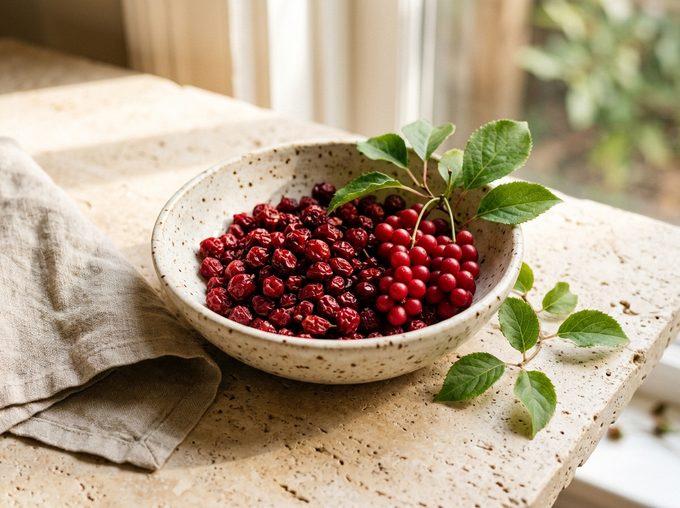
Whole dried schisandra berry for steeping, blending, and cupboard jars.
A little about schisandra berry.
The plant
An extraordinary 'five-flavor' sensory burst: intensely tart-cranberry sour and salty at first, followed by sweet fruitiness, resinous pine-pepper, and a subtle bitter finish. Native to Northern China & Russian Far East (Schisandraceae).
The forms
Most often prepared as a warm berry infusion / decoction using 3 g – 5 g (1 tbsp whole dried berries) at 195°F–205°F (90°C–96°C) (Simmer gently 10–12 min or steep covered 20 min).
Before you choose
Check the label for the Latin name (Schisandra chinensis), and choose the form that suits your cupboard.
Traditional uses & research +
Botanical taxonomy: Schisandra chinensis (Schisandraceae) · Tradition: Adaptogens & Vitality · Key constituents: Schisandrins, Gomisins, Deoxyschisandrin, Organic acids.
Curated collections: Adaptogenic Roots, Berries & Fungi · Ruby Berries & Floral Tisanes · Seasonal almanac: September Almanac (Autumn Equinox Berries & Prairie Cones).
Traditional background: Called Wu Wei Zi ('Five-Flavor Fruit') in classical texts, its skin and pulp are sweet and sour, the inner kernel is pungent and bitter, and the whole berry leaves a subtly salty finish.
Everyday & kitchen uses: Steeped with goji or rosehips into a tart ruby tea, infused into cordials and syrups, or simmered in root blends.
Standard preparation methods (compare all 50 steeping temperatures):
- Warm Berry Infusion / Decoction (3 g – 5 g (1 tbsp whole dried berries) at 195°F–205°F (90°C–96°C)): Simmer gently 10–12 min or steep covered 20 min
- Ruby Five-Flavor Cordial Syrup (1/2 cup dried berries simmered in 2 cups water for 15 min at Strain & stir in 1 cup honey): Store in refrigerator; add 1 tbsp to sparkling water
- Overnight Cold-Steeped Berry Water (1 tbsp whole berries in 16 oz cool water at Room temp / fridge steep): Steep 8–12 hours for a bright tart-sweet pink infusion
Cautions & interactions +
General information, not medical advice. Check with a doctor or pharmacist before using this herb if you are pregnant, breastfeeding, giving it to a child, taking medication or managing a health condition.
Who should use caution: Schisandra can change how the body handles some drugs. Extract of the related Schisandra sphenanthera sharply raised blood levels of tacrolimus, and schisandra lignans affect CYP3A liver enzymes, so do not combine it with tacrolimus or other CYP3A-processed medicines without medical supervision. Extracts stimulated isolated animal uterus and human data are lacking, so avoid it in pregnancy. Safety in breastfeeding and children is not well studied. Long-term safety, especially of concentrated extracts, is not established. Traditional practice also avoids it at the start of a cold or fever.
Species & lookalike verification: True Northern Schisandra is Schisandra chinensis (Wu Wei Zi), which produces larger, plump, glossy dark-red to purple-red berries rich in schisandrin A, B, and C lignans. Southern Schisandra (Schisandra sphenanthera / Nan Wu Wei Zi) has smaller, harder, browner berries with lower schisandrin content.
Cupboard storage (amber glass guide): Because dried schisandra berries are naturally rich in fruit sugars and oils, store in a cool pantry in glass.
Sources & further reading +
Why is Schisandra called the 'Five-Flavor Berry' (Wu Wei Zi)?
In Traditional Chinese Medicine, Wu Wei Zi literally means 'Five-Flavor Seed.' Its skin and pulp are sweet and sour (like tart cranberry), its inner kidney-shaped seeds are pungent-spicy and bitter, and the overall mineral impression includes a subtle salty note—engaging all five classical tastes and corresponding to all five organ networks.
Should you crush Schisandra berries before steeping or leave them whole?
It depends on the flavor you want! The dibenzocyclooctadiene lignans (schisandrins) are concentrated inside the hard inner seeds, which also taste peppery, piney, and bitter. Leaving the berries whole yields a delicious, tart-fruity cranberry-like tea; crushing the seeds in a mortar makes the brew much more resinous and bitter and may release more lignans.
Why doTraditional Chinese herbalists say not to drink Schisandra at the very start of a cold?
Schisandra's intense sour flavor is classified as 'astringent and consolidating'—meaning it helps hold in fluids and energy. In classical herbalism, at the very first sign of a wind-cold, diaphoretic (sweat-inducing) herbs like ginger, peppermint, or elderflower are used first.
Can you eat dried Schisandra berries raw out of hand?
Eating 5 to 10 whole dried berries raw is a traditional trail practice among hunters and hikers in the Russian Far East and northern China, though be prepared for an intense sour-spicy pucker!
Companion Moss & Thyme guides & tools:
- Herbarium Journal: Evening Botanical Tea Rituals & Blending →
- Equipment Guide: Best Loose-Leaf Tea Infusers & Gooseneck Kettles →
- Interactive Calculator: Interactive 3-Part Tea Blend Synergy Builder →
Botanical references:
- Royal Botanic Gardens, Kew — Plants of the World Online: Schisandra chinensis Taxonomic Record ↗
- PubChem / NIH National Library of Medicine: Phytochemical Profile (Schisandrins) ↗
Health and safety sources:
- PMC: Effects of Schisandra sphenanthera extract on tacrolimus in healthy volunteers ↗
- PMC: Controversial Interactions of Tacrolimus with Dietary Supplements, Herbs and Food ↗
- PMC: Uterotonic Plants and their Bioactive Constituents ↗
- PMC: Comprehensive review of Schisandra chinensis lignans ↗
Safety notes checked against the sources below on November 5, 2026.
See the herb in context.
Watch our video guide The Most Powerful Herbs in the World, Explained and explore the plants it introduces.
Explore another herb.