Astragalus Root
Huang Qi • Sweet Yellow Soup-Stock Root of Traditional Tonics.
Explore the common forms, learn a little about the plant, and choose what suits your cupboard.
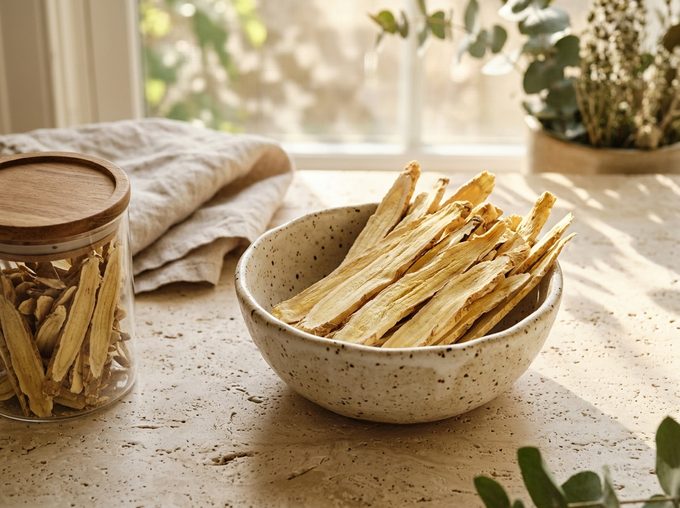
Dried astragalus root pieces for simmering, decoctions, and jars.
A little about astragalus root.
The plant
Mildly sweet, starchy, and pleasantly legume-earthy, reminiscent of mild roasted parsnip or sweet yellow split peas. Native to Northern China & Mongolia (Fabaceae (Legume Family)).
The forms
Most often prepared as a traditional broth / decoction using 5 g – 9 g (2 to 3 long tongue-depressor slices or 1.5 tbsp cut root) at 205°F–212°F low simmer (Simmer covered 25–35 min in water or soup stock).
Before you choose
Check the label for the Latin name (Astragalus membranaceus), and choose the form that suits your cupboard.
Traditional uses & research +
Botanical taxonomy: Astragalus membranaceus (Fabaceae (Legume Family)) · Tradition: Adaptogens & Vitality · Key constituents: Astragalosides (I–VII), Calycosin, Polysaccharides, Saponins.
Curated collections: Adaptogenic Roots, Berries & Fungi · Seasonal Harvest & Winter Apothecary · Seasonal almanac: January Almanac (Midwinter Roots & Pine Needles).
Traditional background: Known as Huang Qi ('Yellow Leader') for the butter-yellow core of its long taproot, astragalus has been simmered into family soup pots across East Asia for centuries.
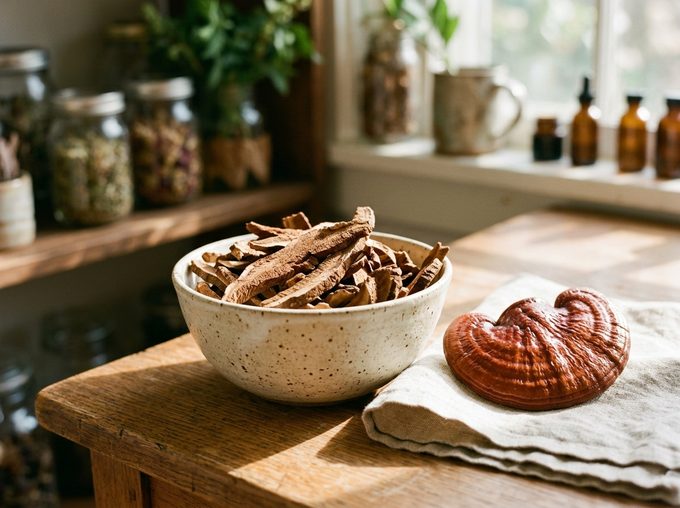
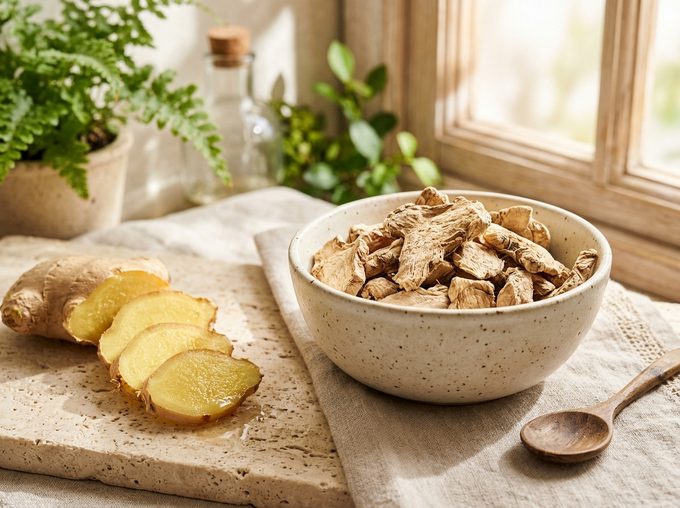
Everyday & kitchen uses: Tossed whole into vegetable or bone broths, rice congee, or decocted with ginger, jujube, and reishi mushroom.
Standard preparation methods (compare all 50 steeping temperatures):
- Traditional Broth / Decoction (5 g – 9 g (2 to 3 long tongue-depressor slices or 1.5 tbsp cut root) at 205°F–212°F low simmer): Simmer covered 25–35 min in water or soup stock
- Everyday Rice / Grain Cooker Method (Drop 2 whole root slices directly into the rice cooker pot at Standard rice cooking cycle): Adds a mild sweet flavor to the rice; remove slices before eating
- Autumn Tonic Pot (3 astragalus slices + 3 reishi strips + 4 ginger slices in 4 cups water at Low covered simmer): Simmer 35 min
Cautions & interactions +
General information, not medical advice. Check with a doctor or pharmacist before using this herb if you are pregnant, breastfeeding, giving it to a child, taking medication or managing a health condition.
Who should use caution: Astragalus may be safe when taken by mouth: up to 60 grams a day for 4 months did not appear to cause harm, but no thorough safety evaluation has been done. Avoid it if you have an autoimmune disease, because it might worsen symptoms. It may interact with immune-suppressing medicines. Little is known about use in pregnancy or breastfeeding, and animal research suggests it may harm the fetus. Safety in children and on the skin is not established. Herbalists traditionally pause it during an active high fever or acute infection.
Species & lookalike verification: CRITICAL FORAGING WARNING: Only use cultivated Asian Astragalus membranaceus (syn. Astragalus propinquus / Huang Qi). About 350 species of wild Astragalus ('Locoweed' or 'Milk Vetch') grow in North America. Most are not toxic, but several cause selenium, nitrotoxin or swainsonine (locoism) poisoning in livestock and wildlife, and all parts of locoweed are toxic to them. Do not eat wild plants.
Cupboard storage (amber glass guide): Keep flat root slices dry in a tall glass jar.
Sources & further reading +
Why does Astragalus root look like wooden tongue depressors?
Traditional Chinese apothecaries steam the harvested 4-year-old taproot until pliable, slice it lengthwise on a diagonal bias, and press it flat while drying. This exposes maximum surface area of the yellow inner xylem so water can penetrate the tough fibers during simmering, while making the slices easy to lift out of a soup pot with chopsticks.
Can you eat the Astragalus root slices after simmering them in soup?
No—even after simmering for an hour, Astragalus root remains as fibrous and woody as bamboo or sugar cane. You drink the rich golden broth and compost the spent root slices, just like a bay leaf.
Why does Astragalus taste slightly sweet and bean-like?
Astragalus membranaceus belongs to the Fabaceae (legume/pea) family. Its roots store high levels of water-soluble astragalans (polysaccharides) and cycloartane saponins (astragalosides I–VII) that impart a pleasant, sweet-savory umami note to vegetable and chicken stocks.
Why do traditional herbalists say to use Astragalus before winter colds rather than during a fever?
In TCM, Huang Qi strengthens 'Wei Qi' (the protective boundary layer). Once an acute feverish illness has already set in, classical practitioners pause heavy tonics so the body can clear heat first, then resume Astragalus during convalescence.
Companion Moss & Thyme guides & tools:
- Herbarium Journal: Covered Infusions vs. Simmered Decoctions →
- Equipment Guide: Best Mortars, Pestles & Apothecary Grinders →
- Interactive Calculator: Infusion vs. Decoction & Safety Checker →
Botanical references:
- Royal Botanic Gardens, Kew — Plants of the World Online: Astragalus membranaceus Taxonomic Record ↗
- PubChem / NIH National Library of Medicine: Phytochemical Profile (Astragalosides (I–VII)) ↗
Health and safety sources:
Safety notes checked against the sources below on November 5, 2026.
See the herb in context.
Watch our video guide The Most Powerful Herbs in the World, Explained and explore the plants it introduces.
Explore another herb.