Ginger
Fiery Golden Rhizome of Warming Teas & After-Meal Infusions.
Explore the common forms, learn a little about the plant, and choose what suits your cupboard.
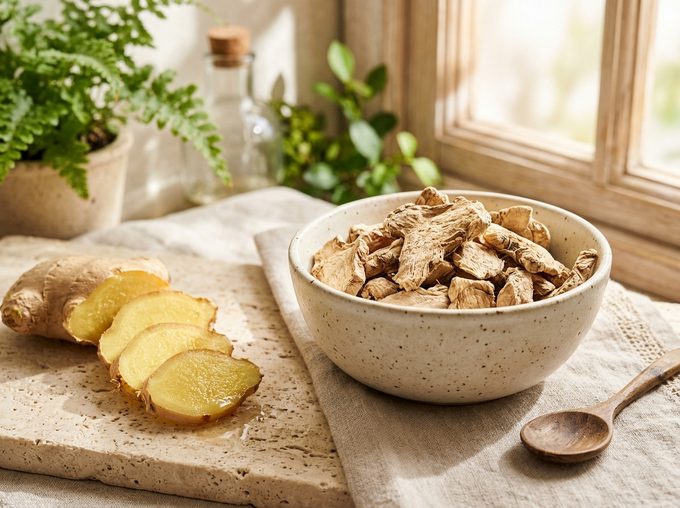
Dried ginger pieces for simmering, decoctions, and jars.
A little about ginger.
The plant
Fiery, pungent, citrusy-warm, and aromatic. Native to Maritime Southeast Asia (Zingiberaceae).
The forms
Most often prepared as a warming rhizome decoction using 2 g – 3 g (1 tsp dried root chips) or 4 thin slices fresh root at 205°F–212°F covered simmer (Simmer 10–15 min covered).
Before you choose
Check the label for the Latin name (Zingiber officinale), and choose the form that suits your cupboard.
Traditional uses & research +
Botanical taxonomy: Zingiber officinale (Zingiberaceae) · Tradition: Digestive & Carminative · Key constituents: Gingerols (fresh), Shogaols (dried), Zingiberene.
Curated collections: Digestive Bitters & Warming Spices · Adaptogenic Roots, Berries & Fungi · Beginner's Home Apothecary Starter Shelf · Seasonal almanac: January Almanac (Midwinter Roots & Pine Needles).
Traditional background: One of the earliest botanicals traded westward along the maritime spice routes into ancient Rome, ginger is known in Sanskrit as Vishwabhesaj ('the universal spice').
Everyday & kitchen uses: Simmered into masala chai, lemon-honey winter decoctions, digestive after-meal teas, and fermented ginger bug sodas.
Standard preparation methods (compare all 50 steeping temperatures):
- Warming Rhizome Decoction (2 g – 3 g (1 tsp dried root chips) or 4 thin slices fresh root at 205°F–212°F covered simmer): Simmer 10–15 min covered
- Lemon-Ginger-Honey Winter Tea (1 tbsp grated fresh ginger + juice of 1/2 lemon + 1 tbsp raw honey at 200°F steep): Steep ginger 10 min; add lemon and honey after cooling to 140°F
- Traditional Blend Addition (Add 1/4 tsp dried ginger chips to any heavy root decoction at Simmer with base herbs): Traditionally described as a circulatory 'driver'
Cautions & interactions +
General information, not medical advice. Check with a doctor or pharmacist before using this herb if you are pregnant, breastfeeding, giving it to a child, taking medication or managing a health condition.
Who should use caution: Ginger in food and tea is generally well tolerated, and up to 4 g daily is the commonly cited limit. It can cause heartburn, stomach upset, diarrhea and mouth or throat irritation, and allergic reactions occur. Ginger can increase bleeding risk with warfarin, so take care with anticoagulants, antiplatelet drugs and bleeding disorders, and avoid supplements near surgery. Reviews advise caution with gallstones and diabetes medicines. Supplements in pregnancy may be safe, though European regulators prefer avoiding them as a precaution. Little is known about breastfeeding.
Species & lookalike verification: Ginger (Zingiber officinale) is botanically an underground stem (rhizome), not a true root. Compare with Galangal (Alpinia galanga, used in Thai cooking, which has pink-tinged ivory rings, a harder woody texture, and a sharp pine-camphor-pepper aroma) and Turmeric (Curcuma longa, deep saffron-orange interior).
Cupboard storage (amber glass guide): Store cut-and-sifted dried ginger in sealed glass; its spicy pungency holds well for 18–24 months.
Sources & further reading +
What is the chemical difference between fresh ginger and dried ginger?
In traditional Chinese and Ayurvedic herbalism, fresh ginger (Sheng Jiang) and dried ginger (Gan Jiang) are treated as two distinct medicines! Fresh ginger is dominated by [6]-gingerol and volatile zingiberene, making it taste brighter and traditionally considered diaphoretic (said to promote a light sweat). When ginger is dried, gingerol dehydrates into [6]-shogaol, which tastes more pungent and is traditionally said to warm internal cold.
Why do herbalists add a pinch of ginger to almost every multi-herb tea formula?
In both Ayurveda (where ginger is called 'Vishwabhesaj', the Universal Medicine) and Traditional Chinese Medicine, a small 5%–10% proportion of ginger is traditionally described as a 'harmonizer and circulatory courier'. This is a traditional idea, not an established effect on absorption.
Does boiling ginger destroy its beneficial compounds?
No—unlike delicate leaf herbs, ginger's pungent compounds (gingerols, shogaols, and paradols) are not simply lost in a simmer, though heat can change some of them. A 10-to-15-minute covered simmer makes a strong, spicy tea.
How do you peel fresh ginger without wasting the flesh?
Skip the vegetable peeler and use the edge of a metal teaspoon—the thin papery skin scrapes right off around every knobby curve while leaving 100% of the oil-rich flesh directly beneath the skin intact.
Companion Moss & Thyme guides & tools:
- Herbarium Journal: Covered Infusions vs. Simmered Decoctions →
- Equipment Guide: Best Mortars, Pestles & Apothecary Grinders →
- Interactive Calculator: Infusion vs. Decoction & Safety Checker →
Botanical references:
- Royal Botanic Gardens, Kew — Plants of the World Online: Zingiber officinale Taxonomic Record ↗
- PubChem / NIH National Library of Medicine: Phytochemical Profile (Gingerols (fresh)) ↗
Health and safety sources:
- NCCIH: Ginger ↗
- EMA HMPC: EU herbal monograph on Zingiber officinale, rhizoma (Rev. 1, 2025) ↗
- StatPearls (NCBI Bookshelf): Ginger Root ↗
- Umbrella review of ginger and metabolic health (PMC13378332) ↗
Safety notes checked against the sources below on November 5, 2026.
See the herb in context.
Watch our video guide The Most Powerful Herbs in the World, Explained and explore the plants it introduces.
Explore another herb.