Turmeric Rhizome
Golden Saffron-Orange Rhizome of Haldi Doodh & Culinary Lore.
Explore the common forms, learn a little about the plant, and choose what suits your cupboard.
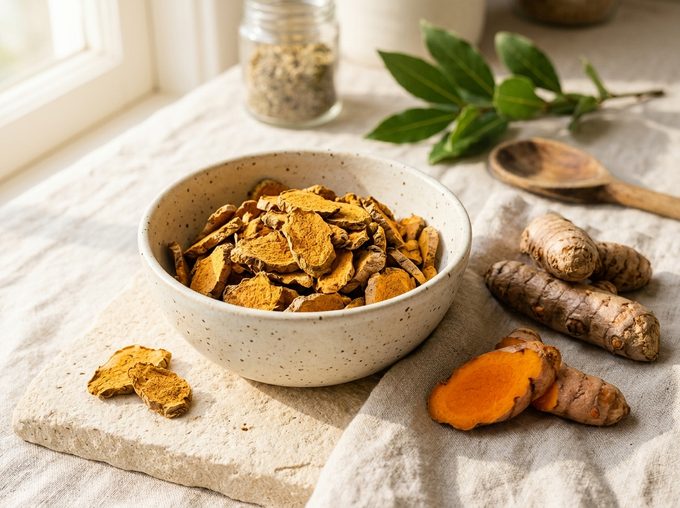
Dried turmeric rhizome pieces for simmering, decoctions, and jars.
A little about turmeric rhizome.
The plant
Earthy, musky, warm-peppery, and mildly bitter with bright orange-ginger aromatic top notes. Native to South Asia (Zingiberaceae).
The forms
Most often prepared as a bioavailable golden milk (haldi doodh) using 1 tsp turmeric root + pinch freshly cracked black pepper + 1/2 tsp ginger in 8 oz milk/coconut milk at 190°F–200°F gentle simmer (Simmer 8–10 min (fat and black pepper are customary in this recipe)).
Before you choose
Check the label for the Latin name (Curcuma longa), and choose the form that suits your cupboard.
Traditional uses & research +
Botanical taxonomy: Curcuma longa (Zingiberaceae) · Tradition: Digestive & Carminative · Key constituents: Curcuminoids (Curcumin), Turmerones, Zingiberene.
Curated collections: Digestive Bitters & Warming Spices · Adaptogenic Roots, Berries & Fungi · Seasonal almanac: November Almanac (Deep Autumn Adaptogens & Woodland Fungi).
Traditional background: Used for over 4,000 years across India as a culinary spice, textile dye, and ceremonial botanical in Haldi traditions.
Everyday & kitchen uses: Simmered as cut root chips in spiced golden teas, golden milk lattes, curries, and warming winter broths.
Standard preparation methods (compare all 50 steeping temperatures):
- Golden Milk (Haldi Doodh) (1 tsp turmeric root + pinch freshly cracked black pepper + 1/2 tsp ginger in 8 oz milk/coconut milk at 190°F–200°F gentle simmer): Simmer 8–10 min (fat and black pepper are customary in this recipe)
- Cut Rhizome Decoction (3 g (1 tsp dried cut rhizome nibs) + 3 cracked peppercorns at 205°F–212°F covered simmer): Simmer 15 min
- Fresh Turmeric-Ginger Fire Cider (1/4 cup grated turmeric + 1/4 cup ginger + 1 tsp peppercorns in 2 cups apple cider vinegar at Cool dark cabinet): Macerate 3–4 weeks, strain, and add raw honey
Cautions & interactions +
General information, not medical advice. Check with a doctor or pharmacist before using this herb if you are pregnant, breastfeeding, giving it to a child, taking medication or managing a health condition.
Who should use caution: Food amounts are generally well tolerated, but turmeric is now among the most common causes of herbal liver injury in the US. Most cases involve highly absorbed curcumin products, including those with black pepper, though ground powder and tea have been implicated. Stop and seek care for fatigue, nausea, dark urine or jaundice. EU regulators advise against it with bile duct obstruction, gallstones or liver disease, and in pregnancy, breastfeeding or under 18. It may raise bleeding risk with warfarin or antiplatelet drugs. Stomach upset and allergic reactions can occur.
Species & lookalike verification: Curcuma longa (Common Orange Turmeric) is distinct from Javanese Turmeric (Curcuma xanthorrhiza) and White Mango Ginger / Zedoary (Curcuma zedoaria, which has pale yellow flesh and a camphor-mango scent).
Cupboard storage (amber glass guide): Keep away from UV light, which gradually fades the vibrant orange curcuminoid pigments.
Sources & further reading +
Why is Turmeric traditionally paired with black pepper and a fat?
Turmeric's primary polyphenols—curcuminoids—are hydrophobic (fat-soluble rather than water-soluble) and are rapidly conjugated by liver enzymes before reaching the bloodstream. Simmering turmeric in a fat-containing liquid (milk, coconut milk, or a drop of ghee/coconut oil) dissolves the curcuminoids, and piperine in black pepper can raise curcumin absorption. Higher absorption is not automatically better: highly absorbed curcumin products have been linked to liver injury.
Why do some buyers choose whole or cut-and-sifted turmeric root over cheap imported yellow powder?
Sadly, low-grade bulk turmeric powders from unverified supply chains have historically been adulterated with starch fillers or lead chromate to fake a bright yellow color. Whole or cut root from a reputable seller may lower this risk, but no label guarantees purity.
How do you remove yellow turmeric stains from skin, blenders, or countertops?
Curcumin is photosensitive and breaks down rapidly under UV light! Leaving a turmeric-stained glass jar, silicone spatula, or cutting board in direct outdoor sunlight for 2–3 hours bleaches the yellow stain completely away.
Is water-only turmeric tea worth making without milk?
It has good flavor, though health benefits are not established. While curcuminoids are fat-soluble, whole turmeric root also contains water-soluble polysaccharides (ukonans) and volatile turmerone oils that infuse into hot water simmered with ginger and lemon.
Companion Moss & Thyme guides & tools:
- Herbarium Journal: Covered Infusions vs. Simmered Decoctions →
- Equipment Guide: Best Mortars, Pestles & Apothecary Grinders →
- Interactive Calculator: Infusion vs. Decoction & Safety Checker →
Botanical references:
- Royal Botanic Gardens, Kew — Plants of the World Online: Curcuma longa Taxonomic Record ↗
- PubChem / NIH National Library of Medicine: Phytochemical Profile (Curcuminoids (Curcumin)) ↗
Health and safety sources:
- NCCIH: Turmeric ↗
- LiverTox: Turmeric ↗
- EMA HMPC: EU herbal monograph, Curcuma longa ↗
- LactMed: Turmeric ↗
Safety notes checked against the sources below on November 5, 2026.
See the herb in context.
Watch our video guide The Most Powerful Herbs in the World, Explained and explore the plants it introduces.
Explore another herb.