Licorice Root
Sweet Root • The Great Harmonizer of Classical Herbal Formulas.
Explore the common forms, learn a little about the plant, and choose what suits your cupboard.
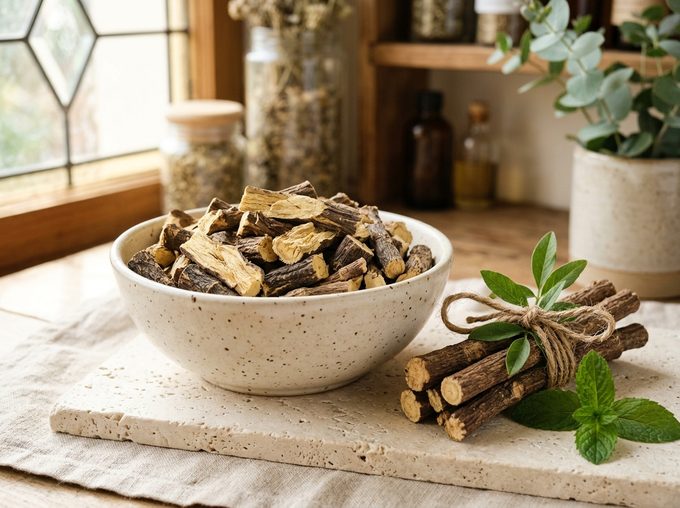
Dried licorice root pieces for simmering, decoctions, and jars.
A little about licorice root.
The plant
Intensely sweet, woody, and earthy-anise with a lingering, throat-coating demulcent finish. Native to Southern Europe & Western Asia (Fabaceae (Legume Family)).
The forms
Used in small pinches (1/4 tsp) as part of a blend rather than on its own.
Before you choose
Check the label for the Latin name (Glycyrrhiza glabra), and choose the form that suits your cupboard.
Traditional uses & research +
Botanical taxonomy: Glycyrrhiza glabra (Fabaceae (Legume Family)) · Tradition: Soothing Demulcents · Key constituents: Glycyrrhizin, Liquiritin, Isoliquiritigenin, Flavonoids.
Curated collections: Aromatic Steams & Soothing Leaves · Digestive Bitters & Warming Spices · Seasonal almanac: June Almanac (Midsummer Blossoms) · October Almanac (Autumn Roots).
Traditional background: Bundles of Glycyrrhiza glabra ('sweet root') were found inside the tomb of King Tutankhamun, and in classical Chinese herbalism (as Gan Cao) it appears in more formulas than any other plant as a 'guide and harmonizer'.
Everyday & kitchen uses: Added in small pinches (1/4 teaspoon) to throat teas, marshmallow root infusions, and bitter root decoctions.
Standard preparation methods (compare all 50 steeping temperatures):
- Formula Harmonizer (5%–10% Ratio) (Add 1/4 tsp licorice root to bitter or spicy herbal blends at Steep or simmer with blend): Rounds out sharp edges and adds natural sweetness without sugar
- Throat-Coat Demulcent Blend (1 tsp marshmallow root + 1/2 tsp licorice root + 1/2 tsp cinnamon at 195°F–205°F): Steep 12–15 min covered
Cautions & interactions +
General information, not medical advice. Check with a doctor or pharmacist before using this herb if you are pregnant, breastfeeding, giving it to a child, taking medication or managing a health condition.
Who should use caution: Licorice root contains glycyrrhizin, which can cause water retention, low potassium, high blood pressure, irregular heartbeat and even cardiac arrest, mainly with large amounts or long use. Small amounts have caused severe effects in people with hypertension, heart or kidney conditions, or high salt intake. Avoid it with those conditions, liver disorders or low potassium. Do not combine it with diuretics, digoxin-type drugs, corticosteroids or stimulant laxatives; it can counteract blood pressure medicines and affect CYP3A4 drugs. A European monograph limits digestive use to 4 weeks. It is not recommended in pregnancy, breastfeeding or under 18.
Species & lookalike verification: True Licorice Root (Glycyrrhiza glabra in Europe/Middle East, and Glycyrrhiza uralensis / Gan Cao in Traditional Chinese Medicine) is a member of the legume (Fabaceae) family whose yellow fibrous roots contain sweet glycyrrhizin, but almost ZERO anise oil! The 'black licorice' flavor people recognize in candy actually comes from adding Aniseed (Pimpinella anisum) or Star Anise (Illicium verum) essential oil.
Cupboard storage (amber glass guide): Store fibrous cut root in sealed jars; keeps its sweetness for years.
Sources & further reading +
Why can drinking too much Licorice Root tea raise blood pressure?
Licorice root contains a triterpenoid saponin called glycyrrhizin. Mainly with large daily amounts or long-term use, though sometimes with small amounts in sensitive people, glycyrrhizin blocks the enzyme that deactivates cortisol in the kidneys, causing the body to retain sodium and water while excreting potassium (pseudoaldosteronism), which raises blood pressure. Stick to small harmonizing amounts (1/4 to 1/2 tsp in blends) and avoid altogether if you have high blood pressure, heart or kidney disease, or low potassium.
What is the difference between whole Licorice Root and DGL?
Whole Licorice Root contains natural glycyrrhizin (which gives the intense sweetness but can raise blood pressure, especially in high doses). DGL (Deglycyrrhizinated Licorice) is an extract with most of the glycyrrhizin removed to reduce blood pressure effects. It might be safe for up to 4 months, but its effect on digestive symptoms is unclear.
Does Licorice Root taste like anise or fennel?
Surprisingly, only slightly! While anise, fennel, and star anise get their aroma from volatile trans-anethole, Licorice Root gets its sweetness from water-soluble glycyrrhizin—giving a deeper, slower-building woody sweetness that lingers on the back of the tongue for minutes.
Why is Licorice Root called the 'Great Peacemaker' (Gan Cao) in Chinese herbalism?
In Traditional Chinese Medicine, Gan Cao is included in more classical formulas than any other herb, where it is traditionally used to harmonize a formula and smooth out harsh, bitter flavors.
Companion Moss & Thyme guides & tools:
- Herbarium Journal: Covered Infusions vs. Simmered Decoctions →
- Equipment Guide: Best Mortars, Pestles & Apothecary Grinders →
- Interactive Calculator: Infusion vs. Decoction & Safety Checker →
Botanical references:
- Royal Botanic Gardens, Kew — Plants of the World Online: Glycyrrhiza glabra Taxonomic Record ↗
- PubChem / NIH National Library of Medicine: Phytochemical Profile (Glycyrrhizin) ↗
Health and safety sources:
- NCCIH: Licorice Root ↗
- EMA HMPC: EU herbal monograph on Glycyrrhiza spp., radix (Rev. 1) ↗
- EMA HMPC: Assessment report on Glycyrrhiza spp. (2026) ↗
- LactMed: Licorice ↗
Safety notes checked against the sources below on November 5, 2026.
See the herb in context.
Watch our video guide The Most Powerful Herbs in the World, Explained and explore the plants it introduces.
Explore another herb.