Sacred Frankincense
Oman Hojari Tears • Translucent Citrus-Pine Oleogum Resin of Antiquity.
Explore the common forms, learn a little about the plant, and choose what suits your cupboard.
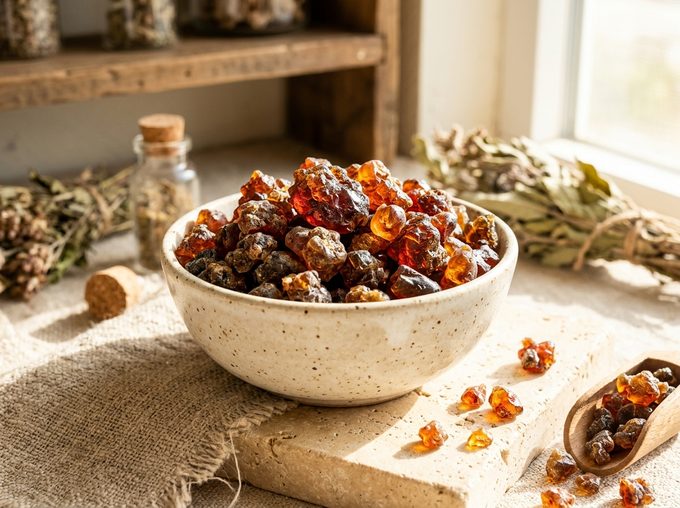
Whole frankincense tears for warming as incense.
A little about sacred frankincense.
The plant
Aromatically luminous, crisp Meyer-lemon citrus, fresh pine needle, and sweet balsamic honey-wood. Native to Dhofar Mountains (Oman), Somalia & Yemen (Burseraceae).
The forms
Most often prepared as a charcoal-free brass warmer (best incense method) using 1 to 2 pea-sized Hojari resin tears on a thin copper/aluminum plate over a tealight candle at 250°F–320°F gentle radiant heat (Melts slowly over 45–60 min, releasing a lemon-pine vapor with little burnt smell; ventilate the room).
Before you choose
Check the label for the Latin name (Boswellia sacra), and choose the form that suits your cupboard.
Traditional uses & research +
Botanical taxonomy: Boswellia sacra (Burseraceae) · Tradition: Sacred Resins & Woods · Key constituents: Boswellic acids (AKBA), Alpha-pinene, Incensole acetate, Limonene.
Curated collections: Sacred Resins & Forest Aromatics · Seasonal Harvest & Winter Apothecary · Seasonal almanac: January Almanac (Midwinter Roots & Pine Needles) · December Almanac (Solstice Resins, Bark Quills & Evergreen).
Traditional background: Harvested from gnarly Boswellia sacra trees clinging to limestone cliffs in Oman's Dhofar region, frankincense drove the ancient Incense Route across the Arabian Peninsula.
Everyday & kitchen uses: Warmed on a brass screen burner for study and meditation spaces, or infused into carrier oils for botanical skincare salves.
Standard preparation methods (compare all 50 steeping temperatures):
- Charcoal-Free Brass Warmer (Best Incense Method) (1 to 2 pea-sized Hojari resin tears on a thin copper/aluminum plate over a tealight candle at 250°F–320°F gentle radiant heat): Melts slowly over 45–60 min, releasing a lemon-pine vapor with little burnt smell; ventilate the room
- Resin-Infused Skin Balm Oil (1 oz crushed resin tears in 8 oz jojoba oil at 120°F warm water bath for 3–4 hours): Oleoresin dissolves into oil while white gum settles to the bottom
Cautions & interactions +
General information, not medical advice. Check with a doctor or pharmacist before using this herb if you are pregnant, breastfeeding, giving it to a child, taking medication or managing a health condition.
Who should use caution: We do not recommend drinking frankincense water or eating the resin, because the safety has not been well studied. Most human data come from Boswellia serrata extracts rather than whole Boswellia sacra tears, and those trials mainly report mild nausea, reflux, diarrhea and abdominal pain. Mild skin redness or itching has been reported. Two case reports link Boswellia to raised INR on warfarin, and caution is advised with cyclosporine and tacrolimus. Data on pregnancy, breastfeeding and children are lacking. Burning incense indoors releases fine particles and irritant gases, so ventilate the room, especially around children and people with lung disease.
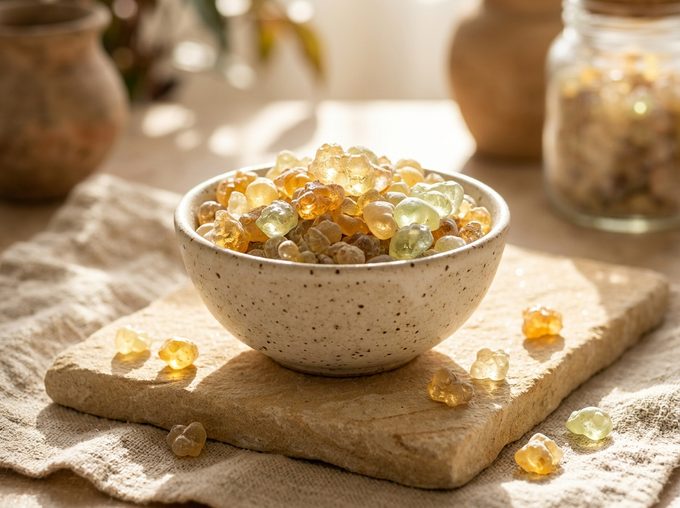
Species & lookalike verification: Four main species of Boswellia produce frankincense: (1) Boswellia sacra from Dhofar, Oman (produces translucent ivory, amber, and jade-tinted 'Royal Hojari' tears—a premium aromatic grade, rich in alpha-pinene); (2) Boswellia carterii from Somalia (warmer, woodier, balsamic); (3) Boswellia frereana ('Maydi' or 'King of Frankincense', golden stalactite tears chewed as gum and burned in churches); and (4) Boswellia serrata from India ('Salai Guggal', darker, earthier, used primarily for standardized boswellic acid extracts).
Cupboard storage (amber glass guide): Keep resin tears in a cool glass jar so they do not stick together in summer heat.
Sources & further reading +
Why does Frankincense smell like burnt wood on charcoal, and how do you fix it?
Frankincense is an 'oleogum resin'—about 65% fragrant essential oil/resin and 30% water-soluble polysaccharide sugar gum. When dropped directly onto a 900°F burning charcoal disc, the fragrant oils flash off in 30 seconds and the remaining sugar gum literally burns like burnt marshmallow! Using a charcoal-free brass tealight warmer (or placing a thin piece of mica/foil with a pinch of salt between the charcoal and the resin) heats the tear gently so it smells like pure lemon-pine sanctuary incense.
Why are the finest Oman Frankincense tears tinted pale green ('Royal Green Hojari')?
Boswellia sacra trees growing in the limestone wadis of eastern Dhofar (Oman), cooled by the summer Khareef monsoon mist, exude translucent tears tinged with delicate jade-green and ivory hues that carry the highest concentration of bright citrus-pine limonene and alpha-pinene.
Can you dissolve Frankincense resin completely in either water or oil?
Because Frankincense is both a 'gum' (water-soluble) and an 'oleoresin' (oil/alcohol-soluble), neither water nor oil alone dissolves 100% of the tear! Soaking tears overnight in water dissolves the milky-white arabinogalactan gum; warming crushed tears in jojoba oil draws out the fragrant terpenes and other oil-soluble compounds while leaving the white gum at the bottom.
Are heavy boswellic acids present in steam-distilled Frankincense essential oil?
No! Boswellic acids (like AKBA) are heavy triterpenoid molecules whose molecular weight is too large to travel over in steam distillation. Frankincense essential oil contains volatile monoterpenes (alpha-pinene, limonene), whereas boswellic acids remain in the whole resin tear or CO2/alcohol extract.
Companion Moss & Thyme guides & tools:
- Herbarium Journal: Covered Infusions vs. Simmered Decoctions →
- Equipment Guide: Best Mortars, Pestles & Apothecary Grinders →
- Interactive Calculator: Infusion vs. Decoction & Safety Checker →
Botanical references:
- Royal Botanic Gardens, Kew — Plants of the World Online: Boswellia sacra Taxonomic Record ↗
- PubChem / NIH National Library of Medicine: Phytochemical Profile (Boswellic acids (AKBA)) ↗
Health and safety sources:
- Frankincense: systematic review (PMC2605614) ↗
- Herb-drug interaction review (PMC8951360) ↗
- Boswellic acids in anti-inflammatory therapy review (PMC12669112) ↗
- Incense smoke and airway disease review (PMC2377255) ↗
Safety notes checked against the sources below on November 5, 2026.
See the herb in context.
Watch our video guide The Most Powerful Herbs in the World, Explained and explore the plants it introduces.
Explore another herb.