White Pine Needle
Five-Needle Evergreen of Eastern Forests, and How to Identify It.
Learn to identify the tree, and why we do not recommend drinking it.
We do not link to pine needle tea because human safety data are lacking.
A little about white pine needle.
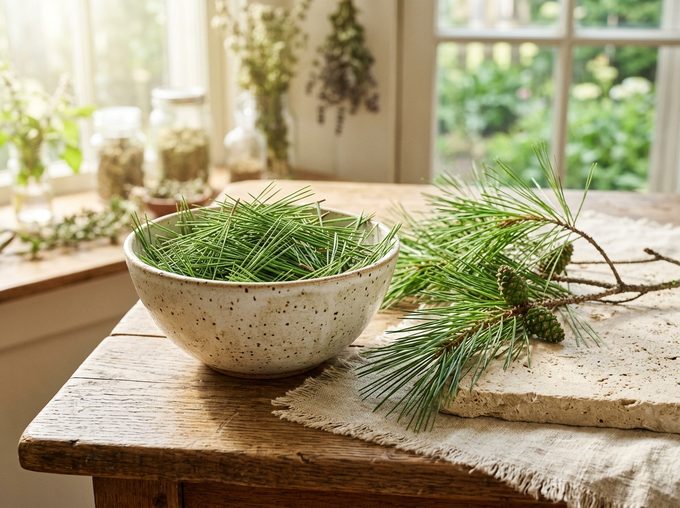
The plant
Crisp, bright, evergreen-citrus aroma. Native to Eastern North America (Pinaceae).
The forms
Not recommended for drinking. Needles can scent a stovetop simmer pot as a room aromatic.
Before you choose
Identify the tree with certainty, and leave any tree you are unsure of.
Traditional uses & research +
Botanical taxonomy: Pinus strobus (Pinaceae) · Tradition: Nutritive & Berry Tonics · Key constituents: Alpha-pinene, Beta-pinene, Shikimic acid, Vitamin C, Flavonoids.
Curated collections: Aromatic Steams & Soothing Leaves · Seasonal Harvest & Winter Apothecary · Sacred Resins & Forest Aromatics · Seasonal almanac: January Almanac (Midwinter Roots & Pine Needles) · December Almanac (Solstice Resins, Bark Quills & Evergreen).
Traditional background: Known to the Haudenosaunee (Iroquois) as the Tree of Peace, Eastern White Pine is easily identified by its soft, flexible needles growing in bundles (fascicles) of five—five letters in W-H-I-T-E.
Everyday & kitchen uses: Simmered as a stovetop room aromatic.
Standard preparation methods (compare all 50 steeping temperatures):
- Winter Stovetop Room Aromatic (1/2 cup pine needles + 2 cinnamon sticks + 1 sliced orange + 4 cloves at Low uncovered simmer pot): Fills the home with natural woodland terpene aroma
Cautions & interactions +
General information, not medical advice. Check with a doctor or pharmacist before using this herb if you are pregnant, breastfeeding, giving it to a child, taking medication or managing a health condition.
Who should use caution: We do not recommend drinking white pine needle tea, because human safety data are lacking. Misidentification is the main danger: yew has flat green needles, and all parts except the fleshy aril are poisonous, with heart effects that can kill. Ponderosa and lodgepole pine needles, through compounds such as isocupressic acid, cause abortion in cattle. Whether this applies to white pine or to people is unknown, so avoid pine needle tea in pregnancy. Safety in breastfeeding and children is not established, and medication interactions are unstudied. Never use a tree you cannot positively identify.
Species & lookalike verification: CRITICAL FORAGING & TOXIC TREE IDENTIFICATION: Eastern White Pine (Pinus strobus) is the ONLY native pine in eastern North America with exactly FIVE soft, flexible, bluish-green needles per bundle (fascicle)—remember: 5 letters in W-H-I-T-E = 5 needles per bundle! NEVER confuse White Pine with: (1) English/Japanese Yew (Taxus baccata / Taxus cuspidata)—Yew has flat, dark-green single needles attached directly to the twig (not in bundles of 5) and red berry-like arils instead of woody pinecones; Yew contains lethal taxine alkaloids and is deadly poisonous! (2) Ponderosa Pine (Pinus ponderosa, 2–3 long stiff needles per bundle), Lodgepole Pine (Pinus contorta), or Norfolk Island Pine (Araucaria heterophylla), which should not be steeped internally.
Cupboard storage (amber glass guide): Keep dried needles in sealed dark glass in a cool cabinet.
Sources & further reading +
How do you identify Eastern White Pine (Pinus strobus)?
Pull off one tiny needle cluster (fascicle) where it joins the twig and count the needles inside that single papery sheath: Eastern White Pine ALWAYS has 5 soft, flexible needles per bundle (5 letters in W-H-I-T-E). Furthermore, it produces woody hanging pinecones—never red berries (which belong to toxic Yew trees and shrubs). If you are not certain, do not use it.
Are winter White Pine needles higher in Vitamin C than summer needles?
Yes—botanical analyses show that evergreen Pinus strobus needles actually increase their intracellular concentration of ascorbic acid and other antioxidants during cold winter months to prevent freezing oxidative damage in their chloroplasts.
Companion Moss & Thyme guides & tools:
- Herbarium Journal: Evening Botanical Tea Rituals & Blending →
- Equipment Guide: Best Loose-Leaf Tea Infusers & Gooseneck Kettles →
- Interactive Calculator: Interactive 3-Part Tea Blend Synergy Builder →
Botanical references:
- Royal Botanic Gardens, Kew — Plants of the World Online: Pinus strobus Taxonomic Record ↗
- PubChem / NIH National Library of Medicine: Phytochemical Profile (Alpha-pinene) ↗
Health and safety sources:
- PMC: Taxus baccata intoxication ↗
- USDA ARS: Pine needles published research ↗
- PMC: Ethnopharmacology of Pinus species ↗
- PMC: Seasonal variation in antioxidant system of eastern white pine needles ↗
Safety notes checked against the sources below on November 5, 2026.
See the herb in context.
Watch our video guide The Most Powerful Herbs in the World, Explained and explore the plants it introduces.
Explore another herb.