Lion's Mane
Yamabushitake • Cascading White Woodland Tooth Fungus.
Explore the common forms, learn a little about the plant, and choose what suits your cupboard.
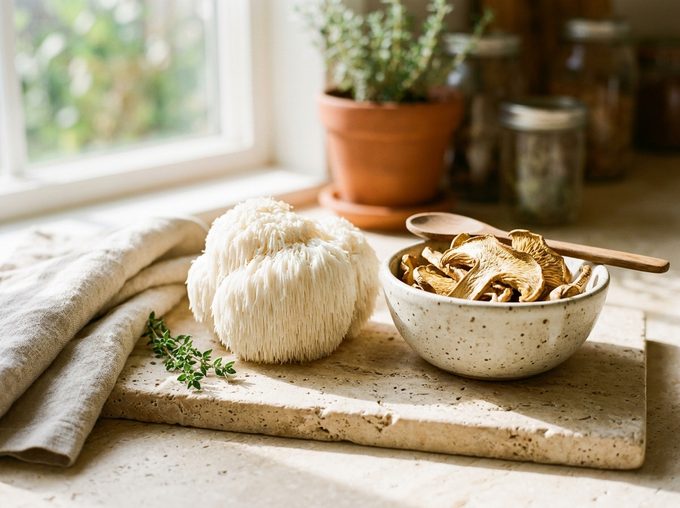
Whole dried lion's mane for steeping, blending, and cupboard jars.
A little about lion's mane.
The plant
Mild, savory, sweet-umami, and remarkably seafood-like. Native to North America, Europe & East Asia (Hericiaceae).
The forms
Most often prepared as a hot-water fruiting body broth using 3 g – 5 g (1 tbsp dried fruiting body slices/powder) at 200°F–208°F gentle simmer (Simmer 15–20 min in water, broth, or coffee).
Before you choose
Check the label for the Latin name (Hericium erinaceus), and choose the form that suits your cupboard.
Traditional uses & research +
Botanical taxonomy: Hericium erinaceus (Hericiaceae) · Tradition: Adaptogens & Vitality · Key constituents: Hericenones, Erinacines, Beta-glucan polysaccharides.
Curated collections: Adaptogenic Roots, Berries & Fungi · Seasonal almanac: November Almanac (Deep Autumn Adaptogens & Woodland Fungi).
Traditional background: Called Yamabushitake ('Mountain Priest Mushroom') in Japan because its cascading white spines resemble the ceremonial fur stoles worn by Yamabushi ascetics.
Everyday & kitchen uses: Whisked as a hot-water fruiting body extract into morning rosemary or tulsi tea, or sautéed fresh as a prized culinary mushroom.
Standard preparation methods (compare all 50 steeping temperatures):
- Hot-Water Fruiting Body Broth (3 g – 5 g (1 tbsp dried fruiting body slices/powder) at 200°F–208°F gentle simmer): Simmer 15–20 min in water, broth, or coffee
- Morning Coffee / Matcha Infusion (1 tsp (2 g) hot-water extracted fruiting body powder at 195°F–200°F): Whisk directly into morning coffee, matcha, or chai
- Culinary Pan-Sear (Fresh or Rehydrated) (Slice into 1/2-inch steaks; dry-sear first to release water at Medium skillet + butter, thyme & garlic): Sear 4–5 min per side until golden-brown and crispy on the spines
Cautions & interactions +
General information, not medical advice. Check with a doctor or pharmacist before using this herb if you are pregnant, breastfeeding, giving it to a child, taking medication or managing a health condition.
Who should use caution: Lion's mane is generally recognized as safe as a food, but supplements are less studied: human trials have been small and short. Reported effects include stomach discomfort, diarrhea, nausea, headache and skin rash. Avoid it if you have a mushroom allergy. One case report described acute respiratory distress in a man who had taken it for years, with test results suggesting an allergic reaction, though the cause was not proven. Safety in pregnancy and breastfeeding, drug interactions and long-term use are not well studied.
Species & lookalike verification: Lion's Mane (Hericium erinaceus) forms a single rounded cascading pom-pom of icicle-like spines (1–4 cm long). Its close North American woodland cousins—Bear's Head Tooth (Hericium americanum) and Coral Tooth (Hericium coralloides)—have branching coral-like arms with shorter spines; these are different species whose chemistry can differ, and a wild mushroom should only be eaten after expert identification.
Cupboard storage (amber glass guide): Keep dried slices or extract powders tightly capped away from steam.
Sources & further reading +
Why can't you just stir raw, unextracted Lion's Mane powder into cold smoothies?
Just like Reishi, raw dried Lion's Mane mushroom has tough chitin cell walls, which is the usual reason given for hot-water extraction. Unless the powder has already been 'hot-water extracted' (spray-dried from a decoction), the usual approach is to simmer dried Lion's Mane in hot liquid for 15 to 20 minutes, though how this affects absorption in people is not well studied.
What is the difference between hericenones and erinacines in Lion's Mane?
Hericenones (A–H) are aromatic compounds found exclusively in the above-ground fruiting body (the shaggy white mushroom), whereas erinacines are diterpenoids formed in the mycelium. Traditional culinary and tonic use relies on the whole fruiting body.
Does Lion's Mane taste bitter like Reishi?
Not at all! Unlike woody, bitter Reishi polypores, Lion's Mane is a soft, fleshy culinary mushroom with a mild, sweet-savory umami flavor that blends effortlessly into coffee, cacao, or soup stock.
How do you test a Lion's Mane powder at home for grain filler (starch)?
Mix 1/2 teaspoon of the mushroom powder into warm water, let it cool, and add 2 drops of pharmacy iodine solution. Pure mushroom fruiting body contains beta-glucans and stays amber-brown; if the liquid turns dark blue-black, it likely contains grain starch (alpha-glucans). Throw the test cup away; do not drink it.
Companion Moss & Thyme guides & tools:
- Herbarium Journal: Evening Botanical Tea Rituals & Blending →
- Equipment Guide: Best Loose-Leaf Tea Infusers & Gooseneck Kettles →
- Interactive Calculator: Interactive 3-Part Tea Blend Synergy Builder →
Botanical references:
- Royal Botanic Gardens, Kew — Plants of the World Online: Hericium erinaceus Taxonomic Record ↗
- PubChem / NIH National Library of Medicine: Phytochemical Profile (Hericenones) ↗
Health and safety sources:
- Systematic review: Benefits and side effects of Hericium erinaceus (PMC12434001) ↗
- Narrative review: Lion's Mane (PMC12030463) ↗
- Overview: Chemical composition of Hericium spp. (PMC11172836) ↗
Safety notes checked against the sources below on November 5, 2026.
See the herb in context.
Watch our video guide The Most Powerful Herbs in the World, Explained and explore the plants it introduces.
Explore another herb.