Common Yarrow
Plume of Achilles • Feathery Leaves & Aromatic White Umbels.
Explore the common forms, learn a little about the plant, and choose what suits your cupboard.
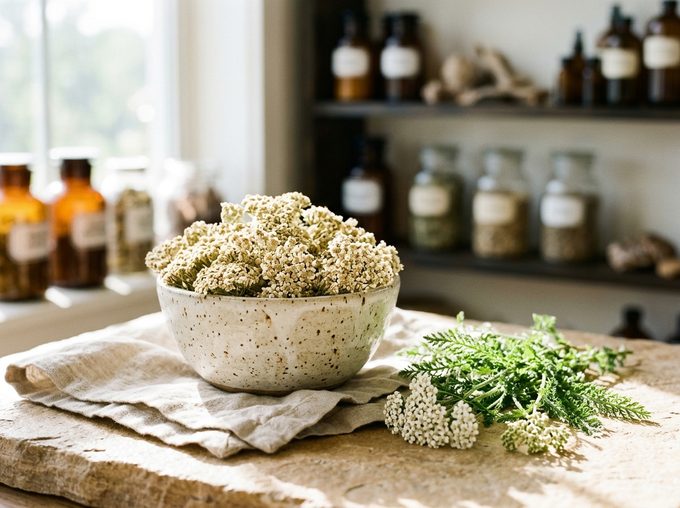
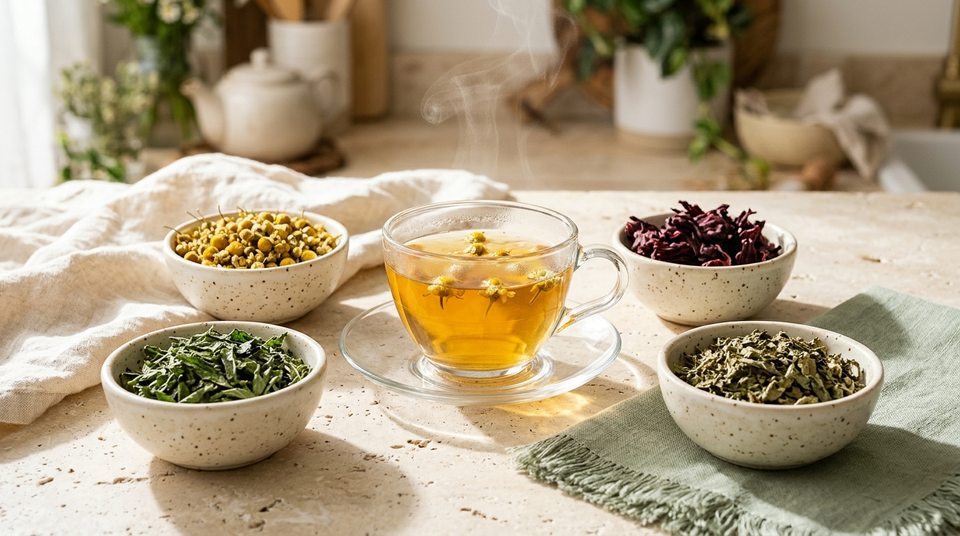
Whole dried common yarrow flowers for steeping and infusions.
A little about common yarrow.
The plant
Aromatic, camphoraceous, piney-sage, and briskly bitter-astringent with a complex herbaceous nose. Native to Temperate Northern Hemisphere (Asteraceae (Daisy Family)).
The forms
Most often prepared as a hot diaphoretic infusion using 1.5 g – 2 g (1 tbsp dried flower heads & feathery leaves) at 200°F–205°F (93°C–96°C) (8–10 min covered (drink warm, the traditional way)).
Before you choose
Check the label for the Latin name (Achillea millefolium), and choose the form that suits your cupboard.
Traditional uses & research +
Botanical taxonomy: Achillea millefolium (Asteraceae (Daisy Family)) · Tradition: Volatile Aromatics · Key constituents: Chamazulene, Achilleine, Cineole, Camphor, Flavonoids.
Curated collections: Aromatic Steams & Soothing Leaves · Seasonal Harvest & Winter Apothecary · Seasonal almanac: August Almanac (Late-Summer Mediterranean Harvest).
Traditional background: Named Achillea after the Greek hero Achilles and millefolium ('thousand-leaved') for its finely divided lace-like foliage, yarrow stalks were also used historically in traditional I Ching divination.
Everyday & kitchen uses: Combined with elderberry/elderflower and peppermint in classic seasonal teas, or infused into botanical skin washes and garden compost preparations.
Standard preparation methods (compare all 50 steeping temperatures):
- Hot Infusion (1.5 g – 2 g (1 tbsp dried flower heads & feathery leaves) at 200°F–205°F (93°C–96°C)): 8–10 min covered (drink warm, the traditional way)
- Cooled Astringent Bitter Tonic (1 tbsp yarrow steeped 10 min, then cooled to room temp at Room temp): Traditionally taken cool as a bitter before meals
- Classic Yarrow-Elderflower-Peppermint ('YEP') Tea (1 tsp yarrow + 1 tsp elderflower + 1 tsp peppermint at 200°F covered steep): The most famous traditional Western herbal winter-chill formula
Cautions & interactions +
General information, not medical advice. Check with a doctor or pharmacist before using this herb if you are pregnant, breastfeeding, giving it to a child, taking medication or managing a health condition.
Who should use caution: Do not use yarrow if you are allergic to plants in the daisy family (Asteraceae), such as ragweed; skin reactions have been reported. Safety in pregnancy and breastfeeding is not established, and EU regulators do not recommend it then. It has a folk reputation as an abortifacient, though thujone in tea is low. It is not recommended under age 12. See a doctor if digestive symptoms last over 2 weeks or cramps over 1 week. Foraged yarrow carries a serious risk of confusion with deadly hemlock, so use only plants you can identify with certainty.
Species & lookalike verification: CRITICAL FORAGING WARNING: Common Yarrow (Achillea millefolium, family Asteraceae) has finely divided, 3D fern-like feathery leaves ('millefolium' = thousand-leaved) with a strong, pleasant sage-camphor aroma and flat-topped clusters of tiny 5-rayed white (or natural rose-pink) flowers. NEVER confuse wild Yarrow in damp ditches with deadly Poison Hemlock (Conium maculatum) or Water Hemlock (Cicuta maculata)—hemlocks belong to the carrot family (Apiaceae), have hollow smooth stems (purple-spotted in poison hemlock), lacy fern-like leaves (so leaf shape alone will not rule them out), umbrella-spoke flower clusters, and, in poison hemlock, a rank smell. If any feature is uncertain, do not use the plant. Avoid yellow-flowered ornamental garden hybrids ('Coronation Gold', Achillea filipendulina) for tea.
Cupboard storage (amber glass guide): Store flowering tops in sealed glass to retain volatile azulene oils.
Sources & further reading +
How do you tell wild Yarrow apart from Poison Hemlock or Queen Anne's Lace?
Use all three checks together and wear gloves, since poison hemlock can cause a skin rash and is highly toxic: (1) Smell a leaf: Yarrow smells strongly of pleasant sage, pine, and camphor, whereas Poison Hemlock smells rank; (2) Look at the leaf—Yarrow has a single hairy stem with soft, 3D feathery plume leaves that look like a miniature squirrel tail, whereas Hemlock has hairless, hollow, purple-spotted stems; (3) Look at the flowers: Yarrow forms flat-topped clusters of small daisy-like heads with a yellow center, whereas hemlock has umbrella-spoke clusters. Hemlock's tiny flowers also have five parts, so counting petals does not help. If you are not certain, do not use the plant.
Why does drinking Yarrow tea hot vs. cold have two different traditional actions?
This is a classic teaching in Western physiomedical herbalism: sipped piping hot under a blanket, yarrow is traditionally said to promote a gentle sweat (diaphoretic). Sipped cool before meals, it is traditionally taken as a bitter for appetite and digestion. These uses rest on tradition, not clinical trials.
What is the traditional 'YEP' tea blend?
'YEP' stands for equal parts Yarrow, Elderflower, and Peppermint—a 200-year-old European and North American household formula steeped hot with honey at the onset of winter chills.
Where does the scientific name Achillea millefolium come from?
According to Homer's Iliad, the centaur Chiron taught the Greek hero Achilles to use yarrow's astringent, tannin-rich feathery leaves ('soldier's woundwort') on the battlefields of Troy.
Companion Moss & Thyme guides & tools:
- Herbarium Journal: Evening Botanical Tea Rituals & Blending →
- Equipment Guide: Best Loose-Leaf Tea Infusers & Gooseneck Kettles →
- Interactive Calculator: Interactive 3-Part Tea Blend Synergy Builder →
Botanical references:
- Royal Botanic Gardens, Kew — Plants of the World Online: Achillea millefolium Taxonomic Record ↗
- PubChem / NIH National Library of Medicine: Phytochemical Profile (Chamazulene) ↗
Health and safety sources:
- EMA HMPC: EU herbal monograph, Achillea millefolium ↗
- EMA HMPC: Assessment report, Achillea millefolium ↗
- USDA Forest Service: Poison Hemlock Field Guide ↗
- USDA Forest Service: Water Hemlock ↗
Safety notes checked against the sources below on November 5, 2026.
See the herb in context.
Watch our video guide The Most Powerful Herbs in the World, Explained and explore the plants it introduces.
Explore another herb.