Valerian Root
Deep-Earth Rhizome of Traditional Nighttime Apothecary Blends.
Explore the common forms, learn a little about the plant, and choose what suits your cupboard.
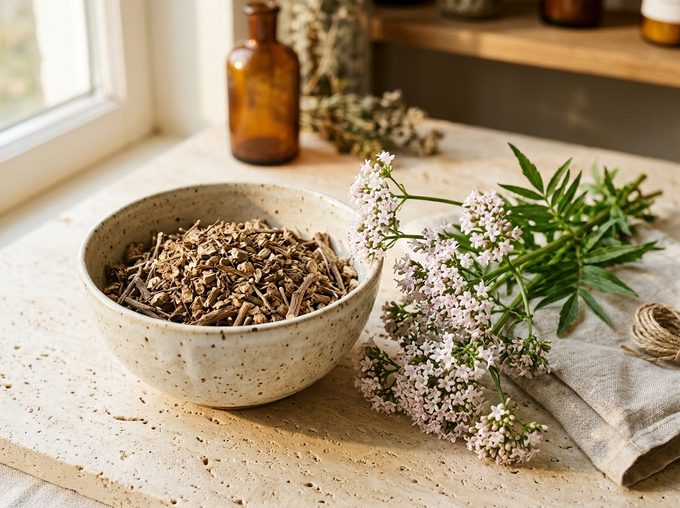
Dried valerian root pieces for simmering, decoctions, and jars.
A little about valerian root.
The plant
Deeply earthy, musky, and pungent-woody with a bittersweet, camphor-balsamic root finish. Native to Europe & Northern Asia (Caprifoliaceae).
The forms
Most often prepared as a warm / sub-boiling root maceration using 2 g – 3 g (1 tsp cut dried root) at 175°F–185°F (80°C–85°C) or room temp (Steep 15–30 min covered (never boil valerian root)).
Before you choose
Check the label for the Latin name (Valeriana officinalis), and choose the form that suits your cupboard.
Traditional uses & research +
Botanical taxonomy: Valeriana officinalis (Caprifoliaceae) · Tradition: Calming Nervines · Key constituents: Valerenic acid, Valepotriates, Bornyl acetate, Sesquiterpenes.
Curated collections: Evening Calm & Bedtime Infusions · Seasonal almanac: October Almanac (First-Frost Taproots & Rosehips).
Traditional background: Described by Galen and Dioscorides under the name Phu for its unmistakable musky root scent, valerian has anchored European nighttime apothecary formulas for two millennia.
Everyday & kitchen uses: Steeped in warm (not boiling) water with strong aromatic companions like peppermint, cardamom, or fennel to round out its earthy profile.
Standard preparation methods (compare all 50 steeping temperatures):
- Warm / Sub-Boiling Root Maceration (2 g – 3 g (1 tsp cut dried root) at 175°F–185°F (80°C–85°C) or room temp): Steep 15–30 min covered (never boil valerian root)
- Cold Overnight Maceration (1 tsp dried root in 8 oz cool water at Room temp / refrigerator): Steep 6–8 hours covered, strain, and warm slightly
- Aromatic Masking Blend (1 tsp valerian + 1 tsp peppermint + 1/2 tsp crushed cardamom at 185°F (85°C)): 15 min covered
Cautions & interactions +
General information, not medical advice. Check with a doctor or pharmacist before using this herb if you are pregnant, breastfeeding, giving it to a child, taking medication or managing a health condition.
Who should use caution: Side effects include headache, stomach upset, mental dullness, excitability, uneasiness and vivid dreams. It may cause sleepiness, so do not drive if affected, and do not take it with alcohol or sedatives. Stopping suddenly after long-term use may cause withdrawal, including anxiety and insomnia. Rare liver injury has been reported, usually with other herbs. Safety in pregnancy and breastfeeding is not established, and EU regulators advise against use then and under age 12. It has been used with apparent safety at 300 to 600 mg daily for up to 6 weeks; long-term safety is unknown.
Species & lookalike verification: Official Valerian is Valeriana officinalis (Common Garden Heliotrope), whose tall hollow stems bear sweet vanilla-scented pink-white flower clusters in summer—in stark contrast to its pungent roots. Never confuse Valeriana officinalis with Red Valerian (Centranthus ruber, a Mediterranean wall flower) or Greek Valerian (Polemonium reptans, a member of the Phlox family).
Cupboard storage (amber glass guide): Keep valerian root in a dedicated airtight mason or amber jar; its volatile isovaleric compounds will scent neighboring herbs.
Sources & further reading +
Why shouldn't you boil valerian root like other roots?
Valerian's valepotriates are very unstable and break down into compounds such as isovaleric acid, a source of its odor. Boiling can fill the kitchen with that smell, so many people prefer a gentler steep, though EU herbal documents do list infusions made with boiling water. Steep valerian in warm (180°F) or cool water in a tightly covered jar.
Why does valerian root smell so strong, and how do you improve the taste?
During drying, natural enzymes cleave isovaleric acid from root esters, creating a strong earthy-musky aroma. Blending valerian root with crushed green cardamom pods, Ceylon cinnamon, peppermint, or lemon balm masks the muskiness.
Why did valerian root make me feel wide awake instead of sleepy?
Excitability, uneasiness and vivid dreams are listed side effects of valerian, though how often they happen is not well established. If valerian makes you feel wired, stop taking it.
Why are cats attracted to dried valerian root?
Actinidine and isovaleric acid in dried valerian root stimulate feline olfactory receptors in much the same way nepetalactone in catnip does—always keep valerian jars tightly sealed if you have cats at home!
Companion Moss & Thyme guides & tools:
- Herbarium Journal: Covered Infusions vs. Simmered Decoctions →
- Equipment Guide: Best Mortars, Pestles & Apothecary Grinders →
- Interactive Calculator: Infusion vs. Decoction & Safety Checker →
Botanical references:
- Royal Botanic Gardens, Kew — Plants of the World Online: Valeriana officinalis Taxonomic Record ↗
- PubChem / NIH National Library of Medicine: Phytochemical Profile (Valerenic acid) ↗
Health and safety sources:
- NCCIH: Valerian ↗
- EMA HMPC: EU herbal monograph, valerian root ↗
- EMA HMPC: Assessment report, valerian ↗
- LiverTox: Valerian ↗
Safety notes checked against the sources below on November 5, 2026.
See the herb in context.
Watch our video guide The Most Powerful Herbs in the World, Explained and explore the plants it introduces.
Explore another herb.