Hyssop
Ancient Sanctuary Herb of Chartreuse Liqueurs & Aromatic Steams.
Explore the common forms, learn a little about the plant, and choose what suits your cupboard.
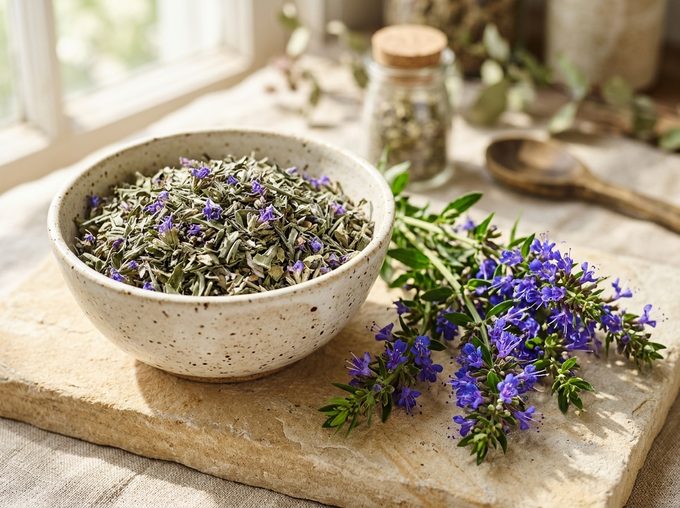
Whole dried hyssop flowers for steeping and infusions.
A little about hyssop.
The plant
Warming, minty-camphoraceous, sage-like, and moderately bitter with a crisp pine-herbal finish. Native to Southern Europe & Caspian Sea (Lamiaceae (Mint Family)).
The forms
Most often prepared as a covered respiratory/digestive steep using 1.5 g – 2 g (1 tsp dried leaf & blue flower tops) at 200°F (93°C) (7–10 min covered).
Before you choose
Check the label for the Latin name (Hyssopus officinalis), and choose the form that suits your cupboard.
Traditional uses & research +
Botanical taxonomy: Hyssopus officinalis (Lamiaceae (Mint Family)) · Tradition: Volatile Aromatics · Key constituents: Marrubiin, Pinocamphone, Isopinocamphone, Diosmin.
Curated collections: Aromatic Steams & Soothing Leaves · Mediterranean Culinary & Hearth Herbs · Seasonal almanac: June Almanac (Midsummer Blossoms) · October Almanac (Autumn Roots).
Traditional background: Cultivated for centuries in Benedictine and Carthusian monastery gardens, hyssop is one of the primary botanicals distilled into traditional Chartreuse and Za'atar variations.
Everyday & kitchen uses: Steeped with honey, thyme, and horehound or mullein in winter herbal infusions .
Standard preparation methods (compare all 50 steeping temperatures):
- Traditional Respiratory/Digestive Steep (1.5 g – 2 g (1 tsp dried leaf & blue flower tops) at 200°F (93°C)): 7–10 min covered
- Monastery Herb Honey Syrup (2 tbsp hyssop + 1 tbsp thyme steeped in 1 cup water for 15 min at Strain & whisk in 1 cup raw honey): Classic European monastery winter spoon-syrup
Cautions & interactions +
General information, not medical advice. Check with a doctor or pharmacist before using this herb if you are pregnant, breastfeeding, giving it to a child, taking medication or managing a health condition.
Who should use caution: Hyssop is considered relatively safe in food amounts, but safe doses for tea or medicinal use are unclear. The essential oil is the main danger: taken internally, it has caused tonic-clonic convulsions in people, linked to pinocamphone, and toxicity can build up with repeated doses. Do not take the oil by mouth. Avoid the oil and medicinal use with epilepsy or past seizures. Very little research covers pregnancy, and hyssop might cause uterine contractions, so avoid it then. Breastfeeding is not well studied. In one asthma trial, hyssop syrup worsened dry cough.
Species & lookalike verification: True Mediterranean Hyssop (Hyssopus officinalis, Lamiaceae) is a compact woody subshrub with narrow, dark green linear leaves and whorls of royal-blue flowers. Distinguish from Anise Hyssop (Agastache foeniculum, a tall North American prairie mint with wide heart-shaped leaves that tastes sweet like root beer/anise and is a different plant with different chemistry) and Giant Korean Hyssop (Agastache rugosa).
Cupboard storage (amber glass guide): Store in dark glass to preserve its cobalt flower color and volatile oils.
Sources & further reading +
What is the difference between True Hyssop (Hyssopus officinalis) and Anise Hyssop (Agastache foeniculum)?
They are completely different genera in the mint family! True Hyssop (Hyssopus officinalis) is a woody Mediterranean subshrub with narrow rosemary-like leaves and a camphor-sage-horehound flavor. Anise Hyssop (Agastache foeniculum) is a native North American bee-garden perennial with broad toothed leaves that tastes sweet and licorice-like.
Why is Hyssop used to make French Chartreuse liqueur?
Since 1737, Carthusian monks in the French Alps have distilled and macerated 130 alpine herbs to create Green and Yellow Chartreuse. Hyssopus officinalis is one of the primary botanicals responsible for Chartreuse's signature spicy, herbaceous finish and natural green color.
Is the Hyssop grown in Europe today the same plant mentioned in the Bible?
Ethnobotanists note that the biblical Hebrew word 'Ezov' (translated into Greek and English as 'hyssop') actually referred to Syrian Oregano / Za'atar (Origanum syriacum), which grows wild across the Levant and is rich in thymol and carvacrol, whereas European monks applied the name to Hyssopus officinalis.
Why does Hyssop taste slightly like old-fashioned horehound candy?
Hyssop contains marrubiin, the exact same bitter labdane diterpene lactone that gives White Horehound (Marrubium vulgare) its classic bitterness.
Companion Moss & Thyme guides & tools:
- Herbarium Journal: Evening Botanical Tea Rituals & Blending →
- Equipment Guide: Best Loose-Leaf Tea Infusers & Gooseneck Kettles →
- Interactive Calculator: Interactive 3-Part Tea Blend Synergy Builder →
Botanical references:
- Royal Botanic Gardens, Kew — Plants of the World Online: Hyssopus officinalis Taxonomic Record ↗
- PubChem / NIH National Library of Medicine: Phytochemical Profile (Marrubiin) ↗
Health and safety sources:
- Review: Hyssopus essential oil, phytochemistry and safety (PMC8776447) ↗
- Systematic review: Essential oils on epilepsy and seizure (PMC6556313) ↗
- PubMed abstract via NCBI E-utilities: PMID 7333081, Toxicity of some essential plant oils ↗
- Trial: Hyssop syrup in mild to moderate asthma (PMC11825080) ↗
Safety notes checked against the sources below on November 5, 2026.
See the herb in context.
Watch our video guide The Most Powerful Herbs in the World, Explained and explore the plants it introduces.
Explore another herb.