Dandelion Root
Lion's Tooth • Earthy Bitter Taproot & Roasted Coffee Alternative.
Explore the common forms, learn a little about the plant, and choose what suits your cupboard.
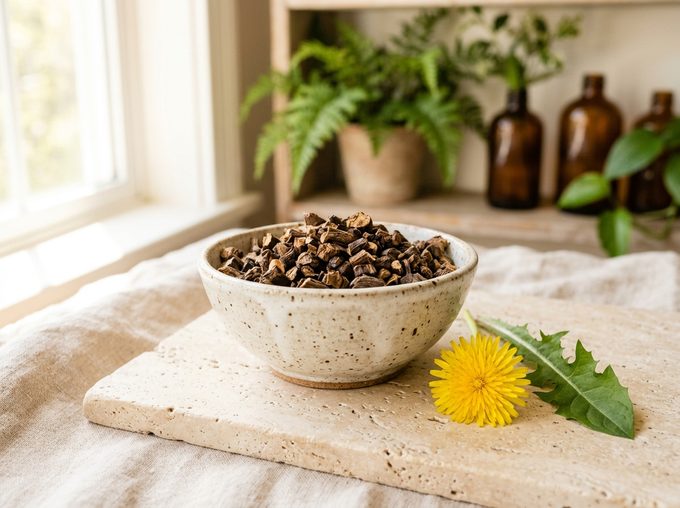
Dried dandelion root pieces for simmering, decoctions, and jars.
A little about dandelion root.
The plant
Raw dried root is earthy, bittersweet, and mineral-rich. Native to Eurasia (Naturalized Worldwide) (Asteraceae (Daisy Family)).
The forms
Most often prepared as a raw root bitter decoction using 3 g – 5 g (1 to 1.5 tsp dried raw cut root) at 205°F–212°F covered simmer (Simmer 15–20 min in 10 oz water).
Before you choose
Check the label for the Latin name (Taraxacum officinale), and choose the form that suits your cupboard.
Traditional uses & research +
Botanical taxonomy: Taraxacum officinale (Asteraceae (Daisy Family)) · Tradition: Digestive & Carminative · Key constituents: Inulin (prebiotic fiber), Taraxacin, Sesquiterpene lactones.
Curated collections: Digestive Bitters & Warming Spices · Seasonal Harvest & Winter Apothecary · Seasonal almanac: March Almanac (Early Spring Mineral Greens & Bitters) · October Almanac (First-Frost Taproots & Rosehips).
Traditional background: From the French dent-de-lion ('lion's tooth') describing its jagged leaves, dandelion was carried intentionally by European settlers across the globe as an essential spring and autumn household plant.
Everyday & kitchen uses: Roasted dandelion root is simmered with chicory, cinnamon, and cardamom for a rich caffeine-free espresso-style cup; raw root pairs with burdock.
Standard preparation methods (compare all 50 steeping temperatures):
- Raw Root Bitter Decoction (3 g – 5 g (1 to 1.5 tsp dried raw cut root) at 205°F–212°F covered simmer): Simmer 15–20 min in 10 oz water
- Roasted Dandelion Root 'Coffee' (1 tbsp dark-roasted cut root + 1/2 tsp cinnamon at 212°F French press or simmer): Simmer 10 min; add warm milk or oat milk
- Spring/Autumn Bitters Tincture (1:5 dried root in 45% vodka/brandy at Dark glass maceration): Take 15–20 drops in water 15 min before heavy meals
Cautions & interactions +
General information, not medical advice. Check with a doctor or pharmacist before using this herb if you are pregnant, breastfeeding, giving it to a child, taking medication or managing a health condition.
Who should use caution: Dandelion may stimulate bile flow, so the root is not recommended with bile duct obstruction, cholangitis, gallstones, liver disease or other biliary disease. Do not use it if you are allergic to daisy-family plants (Asteraceae). Topical use may cause reactions in people with eczema. It might interact with diabetes drugs, blood thinners, antiplatelet drugs and water pills, and a diuretic effect could in theory cause lithium toxicity. People with kidney failure, diabetes or heart failure should avoid it because of high potassium risk. Safety above food amounts in pregnancy and breastfeeding is not well studied, and use under age 12 is not established.
Species & lookalike verification: Common Dandelion (Taraxacum officinale) has hairless, deeply jagged tooth-edged leaves ('dent-de-lion' = lion's tooth) and hollow, leafless flower stalks that exude white latex sap, each bearing a single flower head. Its most common lawn lookalike, Cat's Ear / False Dandelion (Hypochaeris radicata), has hairy, rounded-lobe leaves and solid, branching flower stems.
Cupboard storage (amber glass guide): Store roasted root in an airtight coffee canister or amber jar to keep its toasted aroma crisp.
Sources & further reading +
Why does autumn-harvested dandelion root taste sweeter than spring-harvested root?
In spring, the dandelion taproot expends its stored sugars to push up leaves and yellow blossoms, leaving the spring root thinner and more sharply bitter (high in taraxacin sesquiterpenes). By late autumn after the first frost, the root is packed with up to 40% inulin—a prebiotic fructan fiber that roasts into rich caramel notes.
What is the difference between Dandelion Root tea and Dandelion Leaf tea?
In herbalism they serve two distinct roles: Dandelion Root is traditionally linked with digestion and bile flow and contains inulin fiber (simmered as a decoction), whereas Dandelion Leaf is a potassium-rich bitter green traditionally steeped as a mild diuretic infusion.
How do you roast raw dried dandelion root at home for herbal coffee?
Spread raw cut-and-sifted dandelion root nibs in a single layer on a dry baking sheet and roast at 350°F (175°C) for 18–25 minutes, stirring halfway, until the kitchen smells like toasted cacao and the root pieces turn dark espresso brown.
Why do herbalists taste bitter herbs like dandelion root on the tongue?
Bitter principles such as sesquiterpene lactones are thought to prompt digestive secretions by a reflex from bitter receptors, and this is the traditional reason for tasting them. It has not been shown to be an established effect of dandelion in people.
Companion Moss & Thyme guides & tools:
- Herbarium Journal: Covered Infusions vs. Simmered Decoctions →
- Equipment Guide: Best Mortars, Pestles & Apothecary Grinders →
- Interactive Calculator: Infusion vs. Decoction & Safety Checker →
Botanical references:
- Royal Botanic Gardens, Kew — Plants of the World Online: Taraxacum officinale Taxonomic Record ↗
- PubChem / NIH National Library of Medicine: Phytochemical Profile (Inulin (prebiotic fiber)) ↗
Health and safety sources:
- NCCIH: Dandelion ↗
- EMA HMPC: EU herbal monograph, Taraxacum officinale radix ↗
- EMA HMPC: Assessment report, Taraxacum radix cum herba ↗
Safety notes checked against the sources below on November 5, 2026.
See the herb in context.
Watch our video guide The Most Powerful Herbs in the World, Explained and explore the plants it introduces.
Explore another herb.