California Poppy
Copa de Oro • Sunlit Golden State Wildflower of Evening Herbal Tradition.
Explore the common forms, learn a little about the plant, and choose what suits your cupboard.
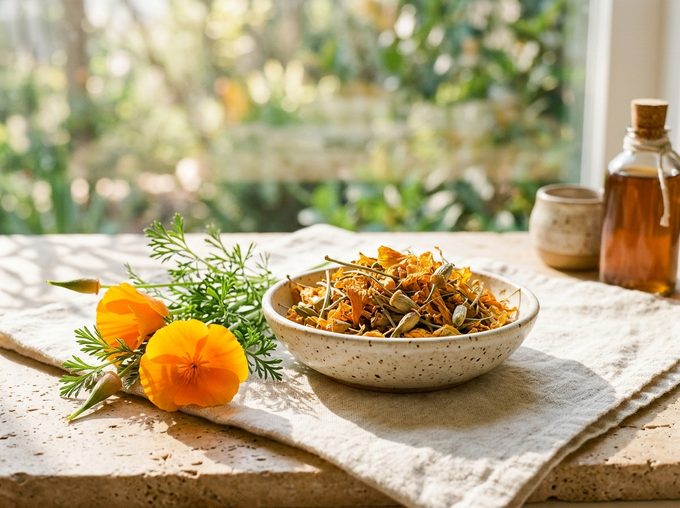
Whole dried california poppy flowers for steeping and infusions.
A little about california poppy.
The plant
Distinctly earthy and mildly bitter-vegetal. Native to California & Western North America (Papaveraceae).
The forms
Most often prepared as a evening aerial infusion using 1.5 g – 2 g (1 tbsp cut aerial plant & petals) at 200°F (93°C) (8–10 min covered).
Before you choose
Check the label for the Latin name (Eschscholzia californica), and choose the form that suits your cupboard.
Traditional uses & research +
Botanical taxonomy: Eschscholzia californica (Papaveraceae) · Tradition: Calming Nervines · Key constituents: Californidine, Eschscholtzine, Protopine, Carotenoids.
Curated collections: Evening Calm & Bedtime Infusions · Seasonal almanac: June Almanac (Midsummer Lavender & Sunlit Blossoms).
Traditional background: Called Copa de Oro ('Cup of Gold') by early Spanish explorers, California poppy nyctinastically closes its silky orange petals every night and on cloudy days.
Everyday & kitchen uses: Used in evening herbal tea blends and botanical tinctures alongside passionflower and chamomile.
Standard preparation methods (compare all 50 steeping temperatures):
- Evening Aerial Infusion (1.5 g – 2 g (1 tbsp cut aerial plant & petals) at 200°F (93°C)): 8–10 min covered
- Aromatic Twilight Blend (1 tsp California poppy + 1 tbsp lemon balm + 1 tsp chamomile at 200°F (93°C)): 8 min covered
- Apothecary Tincture (1:2 fresh whole flowering plant in 50% alcohol at Dark glass maceration): Steep 4 weeks
Cautions & interactions +
General information, not medical advice. Check with a doctor or pharmacist before using this herb if you are pregnant, breastfeeding, giving it to a child, taking medication or managing a health condition.
Who should use caution: In Europe, California poppy is a traditional medicine for adults, for mild stress and sleep. Use under age 18, in pregnancy and while breastfeeding is not recommended because safety has not been established. It may impair your ability to drive or use machines. Interactions have not been studied, so avoid combining it with sedatives. No side effects were reported in the European assessment, but clinical safety data are essentially absent, including long-term data. Seek advice if symptoms last beyond two weeks.
Species & lookalike verification: CRITICAL DISTINCTION: California Poppy (Eschscholzia californica)—the golden-orange state wildflower of California with feathery blue-green foliage—contains isoquinoline alkaloids (californidine, eschscholzine, and protopine). Morphine and codeine are not among the alkaloids listed for it in the European assessment. Never confuse it with the Opium Poppy (Papaver somniferum).
Cupboard storage (amber glass guide): Store away from direct light to preserve the orange-gold petal fragments among the feathery green foliage.
Sources & further reading +
Does California Poppy contain opium or cause a positive drug test?
Morphine, codeine and thebaine are not among the alkaloids listed for Eschscholzia californica in the European assessment; its main alkaloids include californidine, eschscholzine and protopine. However, one medical review says California poppy contains trace opium that can show up in urine drug screens, so individuals subject to strict workplace testing should exercise caution.
Is it illegal to pick wild California Poppies?
In California, it is illegal to pick or damage flowers growing on state highways, state parks, or public lands (California Penal Code 384a), though it is completely legal to grow and harvest Eschscholzia californica on your own garden property or purchase cultivated organic dried herb.
Why do California Poppy flowers close up at night and on cloudy days?
The plant exhibits nyctinasty—differential cell growth at the base of the petals causes the golden cup to furl tightly shut each evening at dusk or during cold wind to protect its pollen from night dew.
How do you balance the bitter flavor of California Poppy in tea?
Pair 1 part California Poppy with 2 parts Lemon Balm or Peppermint and 1 part Linden or Chamomile, finished with a drizzle of raw honey.
Companion Moss & Thyme guides & tools:
- Herbarium Journal: Evening Botanical Tea Rituals & Blending →
- Equipment Guide: Best Loose-Leaf Tea Infusers & Gooseneck Kettles →
- Interactive Calculator: Interactive 3-Part Tea Blend Synergy Builder →
Botanical references:
- Royal Botanic Gardens, Kew — Plants of the World Online: Eschscholzia californica Taxonomic Record ↗
- PubChem / NIH National Library of Medicine: Phytochemical Profile (Californidine) ↗
Health and safety sources:
- EMA: EU herbal monograph, Eschscholzia californica herba ↗
- EMA: Assessment report, Eschscholzia californica herba ↗
- Opioids and sickle cell disease review (PMC) ↗
Safety notes checked against the sources below on November 5, 2026.
See the herb in context.
Watch our video guide The Most Powerful Herbs in the World, Explained and explore the plants it introduces.
Explore another herb.